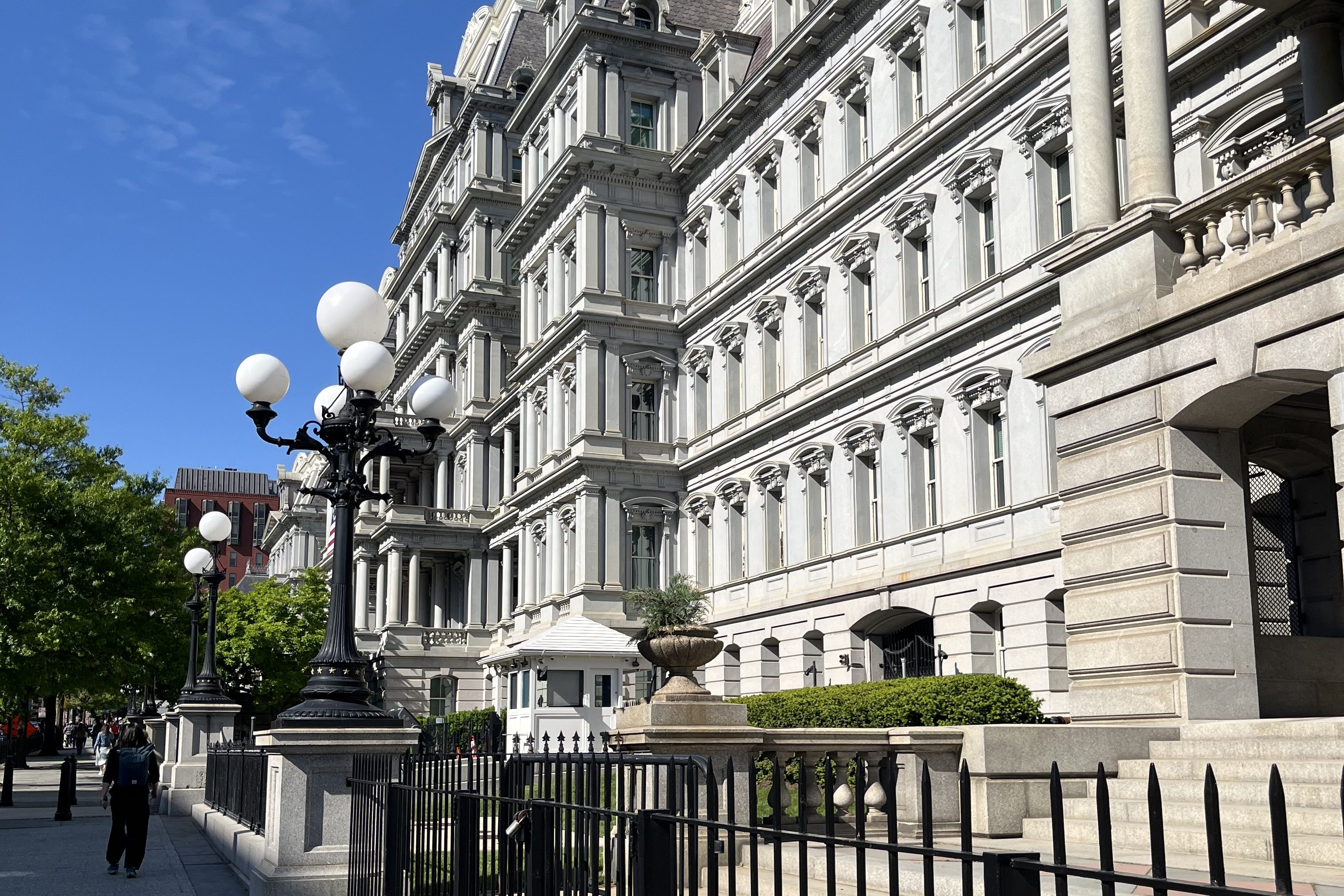
Eisenhower Memorial Controversy
Please see Susan's brother David Eisenhower's statement and her father John Eisenhower's letter on the matter.
Reflections on the past: Remembering Andrei Sakharov
As the holiday season gets underway, the Washington political scene has been busier than ever. In recent news, the health care bill continues to undergo adjustments, the Democrats are proposing to raise the federal debt ceiling, and the President has outlined his strategy for Afghanistan, a discussion of which is ongoing. This is considerable activity given ordinary Washington Christmas seasons. But these are not ordinary times.
The bracing temperatures and the early evenings are evocative of other unforgettable holiday seasons, including one twenty years ago—when the news that Soviet Nobel Laureate, physicist, human rights advocate, and anti-Afghan war protester, Andrei Sakharov, was dead.
I remember, vividly, the unfathomable news. The historic meeting of the Soviet Congress of People’s Deputies was underway, just after the first competitively held elections in the Soviet Union. It was a tumultuous gathering and during one of the most contentious moments, Sakharov, an elected member, rose to present his draft Constitution of the Soviet Union. The response to his proposal was electrifying, yet frightening at the same time. The struggle for the future of the country had reached a critical point, especially in light of the political upheaval in Eastern Europe. Fear, anger, patriotism, betrayal, shock — all were deeply felt and utterly palpable. On December 14, just days after Sakharov’s emotional presentation, the news broke that the father of radical reform in the USSR was dead of a heart attack. Read more…
A New Eisenhower-Khrushchev Conversation

On September 26, 2009, Susan Eisenhower and the son of Nikita Khrushchev gave a talk at at the 50th anniversary of Khrushchev and Dwight Eisenhower’s meeting in Gettysburg.
The Eisenhower Institute at Gettysburg College presented a weekend to commemorate the visit and examine the future of U.S. and Russia relations.
Ms. Eisenhower’s conversation with Sergei Khrushchev was moderated by Daun van Ee, co-editor of the Eisenhower Papers.
A veteran remembers Walter Cronkite
Walter Cronkite, who died this last week at age 92, was one of the giants of the newspaper and television industry, and it is totally fitting that his passing has received such widespread notice. This despite the fact that Cronkite left his position as anchor of CBS News twenty-eight years ago. He is best remembered for a sobriquet “the most trusted man in America.” Though such an accolade was doubtless the brainchild of some promoter, it rings so true that it is repeated over and over again.
As one who counted him as a friend, I feel a very special sadness. Though today he is remembered principally for his role in establishing the television anchor, the veterans of the Second World War hold the name Walter Cronkite with a special warmth, much like that of Ernie Pyle. We feel that he was one of us.
He took risks greater than those of most frontline soldiers. The various tributes being rendered nearly all mention that he accompanied a B-17 bomber on a raid over Germany, but they rarely note that he glided into Holland with the 101st Airborne (Screaming Eagles) in the fall of 1944. He was later at Bastogne during the Battle of the Bulge.
There were no heroics in him; he was far too secure in himself to be pretentious. Forty years ago, when I was writing a book about the Bulge, I wrote Walter about a minor incident in which he and several other reporters politely declined General Maxwell Taylor’s offer of a jeep ride through particularly dangerous territory. Taylor had an urgent reason to make the trip; he was desperate to rejoin his division (again the 101st), which was bottled up in Bastogne. The reporters had no such motivation. To my question, however, Walter made no excuses; he simply wrote “I chickened.” Read more…
The passing of three American giants
The last few weeks have seen the passing of some great American figures: Robert McNamara, Walter Cronkite and Frank McCourt. I was fortunate to have met each on more than one occasion, though I knew McNamara very well. In the late 1980s, in the last days of the Soviet Union, he and I were recruited to be part of an international foundation established in Moscow. It did a great deal of work on nuclear arms control and other security issues. But through the conduct of its business, it made many other contributions. For one thing, it was the first US-Soviet board of its kind. And in 1988, we were the organization that managed to bring our fellow board member Andrei Sakharov to the West for the first time. The International Foundation for the Survival and Development of Humanity, named by Sakharov himself, was the source of many stories in my 1995 book, Breaking Free.
Over the course of these years, and after many trips together, I became fond of “Bob” as we called him. McNamara was a dynamic hard-charger, but also a thoughtful man who spent increasing time thinking about his legacy and the impact of his many decisions and personal choices. One could not help but empathize with him, quite aside from the nature of his role and the weight of history’s verdict. He was a man engaged with his conscience, especially in the lengthening days of his life, and he generously shared his feelings with many of us. Bob and I may have seemed like an odd pair of friends—given the age difference and political affiliation—but I valued his friendship and the strong sense of accountability he felt for his past. Like many others, I will miss him greatly. Read more…
Real Time with Bill Maher
Susan Eisenhower appeared on the July 24 episode of “Real Time with Bill Maher” on the HBO cable network.

Please click here to view a video clip of the “Overtime” segment, in which the panel answered a variety of questions from the internet audience. On the panel with Ms. Eisenhower are war veteran and political candidate Anthony Woods; writer John Heilemann; and writer Matt Taibbi.
Pressing That Re-set Button
On June 22, 2009, Susan Eisenhower moderated a roundtable discussion entitled “Pressing That Re-set Button: Shared Interests, Competing Values, and U.S.-Russian Relations.” The Century Foundation presented this event at the National Press Club in Washington, D.C.
As the Obama administration redirects U.S. policy on many fronts, the President’s declaration of a fresh start for relations between the United States and Russia has significant implications for the management of many critical issues. The roundtable assessed the direction of policy under the new administration in the week ahead of President Obama’s visit to Moscow, and it explored the challenges and opportunities the two countries face on issues of mutual and global concern.
Panelists:
* Jack F. Matlock, Jr., former George F. Kennan Professor, Institute for Advanced Study and former U.S. ambassador to the USSR; co-chair, Century Foundation Working Group on U.S. Policy toward Russia
* Thomas Graham, Senior Director, Kissinger Associates and former Senior Director for Russia, National Security Council; author of Century Foundation report Resurgent Russia and U.S. Purposes
* Sarah E. Mendelson, Director, Human Rights and Security Initiative and Senior Fellow, Russia and Eurasia Program, Center for Strategic and International Studies; author of Century Foundation report U.S.-Russian Relations and the Democracy Deficit
65th Anniversary of D-Day
“Good afternoon. Thank you, President Sarkozy, Prime Minister Brown, Prime Minister Harper, and Prince Charles for being here today. Thank you to our Secretary of Veterans Affairs, General Eric Shinseki, for making the trip out here to join us. Thanks also to Susan Eisenhower, whose grandfather began this mission 65 years ago with a simple charge: “Ok, let’s go.” And to a World War II veteran who returned home from this war to serve a proud and distinguished career as a United States Senator and a national leader: Bob Dole” -President Barack Obama, June 5, 2009
All of us are witnesses to history in the making. Yet our current events are inextricably intertwined with the past. This is one of the points that was so eloquently made atop Omaha Beach today.
I attended that ceremony in Normandy. Here WWII’s Western Allies marked the 65th Anniversary of D-Day. The program, held at the American Cemetery at Colleville-sur-Mer, was attended by an estimated 8,000 people. Among them were more than 150 veterans. President Barack Obama gave prepared remarks, as well as President Nicholas Sarkozy (France) and Prime Ministers Gordon Brown (Great Britain and Northern Ireland) and Stephen Harper (Canada). His Royal Highness The Prince of Wales was an honored guest, but did not address the gathering.

On May 13, 2009, Susan Eisenhower delivered remarks and hosted a panel at the U.S. Chamber of Commerce’s Institute for 21st Century Energy as part of “A Dialogue on Energy Security with America’s Business Leaders.”
Ms. Eisenhower was joined by three regional business leaders for the panel discussion: Robert “Bobby” Wegener, Secretary of Energy, State of Oklahoma; Laurence Weatherly, Ph.D., Chairman, University of Kansas Energy Council; and Bray Cary, President and Chief Executive Officer, West Virginia Media.
Examining The Media-Military Relationship

In May, Susan Eisenhower moderated a panel at the first Civilian-Military Safe Havens Conference in Pocantico Hills, New York. The conference was organized by The Eisenhower Project and The Open Society Institute in collaboration with members of the Department of Social Sciences, United States Military Academy at West Point.
General John J. Sheehan and Dan Rather joined Ms. Eisenhower for the panel, entitled “From Birth of a Nation to YouTube: The Media-Military Relationship Through Time.” A summary of their discussion:
From the earliest joint ventures between the American military and media to the more strained years of Vietnam up to the recent collaborations of the Iraq War, the military-media relationship has been an ever-changing one. Against this historical backdrop, this panel will explore challenging questions about the pros and cons of contemporary war coverage — from the benefits of transparency to the challenging ethical implications of embedding and the inevitable reality that military personnel who appear as experts on television and radio must strike a balance between providing independent expertise and adhering to official talking points. What better avenues for collaboration may be established between officers and their media counterparts in order to give voice to professional military expertise and concerns on aspects of on public policy while maintaining a high regard for the vital security, hierarchy, and safety of military operations.
Photo by Joe Posner/The Eisenhower Project
www.whywefight.com